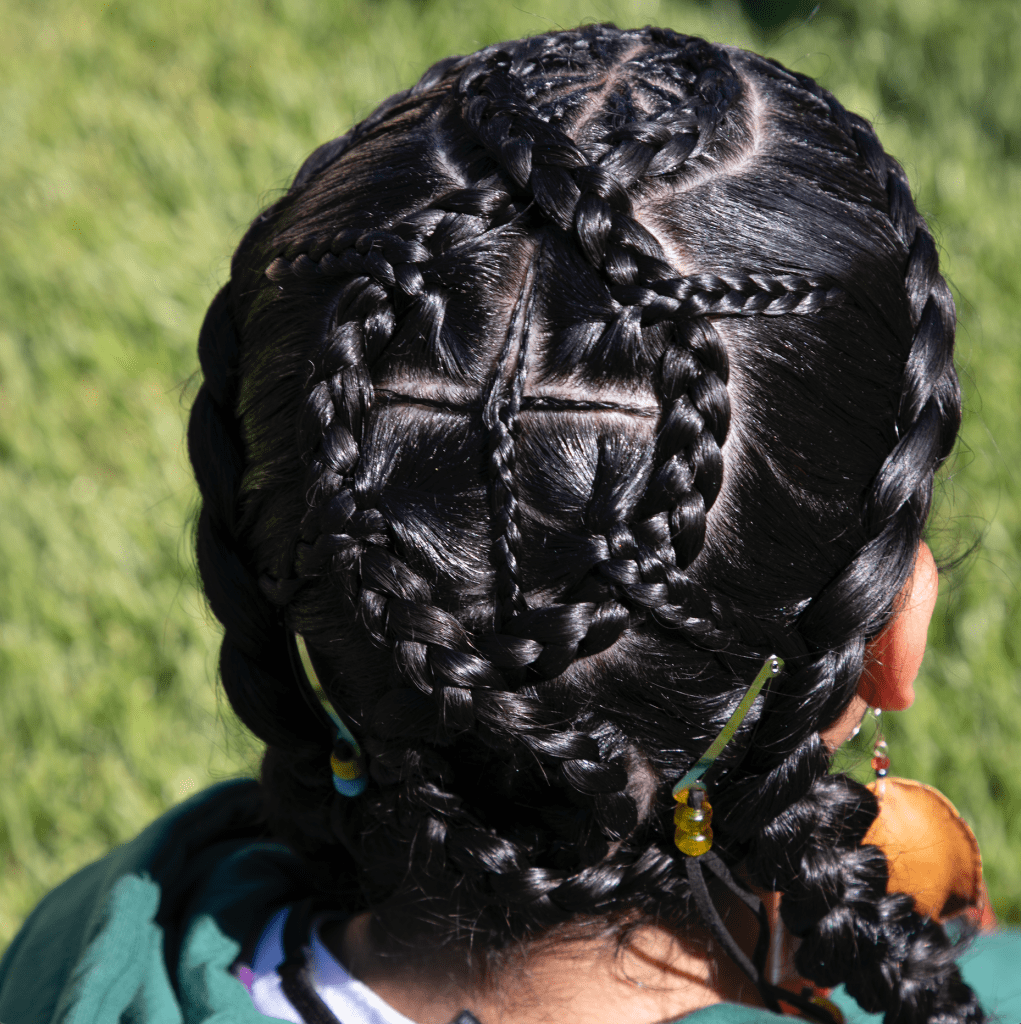
Native Hair is one of those topics you rarely think about. What defines native hair? What does it look like? But it is one of the most significant pieces of native culture that carries so many traditions and stories that have been passed down through generations. As well as a key understanding of our spirit as spiritual beings. Every Native culture has their own customs to their hair, and every Native culture has had their own experience in relationship to colonization as well. For the most part, our hair is what holds our spirit. An extension of our thoughts and dreams. It has the potential to protects us and to even heal us. Tasé Kitten Montaño (Gila River Reservation Sacaton, AZ) who goes by Skittzz, who is a professional intricate braider at San Jose’s finest hair salon called Faded Barbershop, does just that.
“I don’t like to braid when I’m having a bad day, I don’t like to put that energy into the hair, I believe that our skin holds energy and our body is frequency,” says Skittzz. When she is working on a bad day, she can notice the difference in the quality of the braids and the client’s experience, and so prefers to ground herself. She connects to the source of her healing energy and shares that energy with other people through the intricate process of braiding. Braiding has taught her patience and grounding, and with braiding she has opened up a more spiritual door. She has studied a lot of different religions but couldn’t connect with any and turned away from it all. While braiding, it has opened a spiritual gate because it’s like a meditation for her, when she’s braiding, that’s her full meditation, she’s releasing her thoughts and is more open to positive energy. Sometimes clients come in having a bad day and by the time they leave they are completely uplifted, says Skittzz. This is because she is providing a healing experience. By feeling the vibe of her clients, she can then work with them to do the braids. When she’s done with her work day, she reflects back to see what worked. What worked to heal this person or that person and continues to build her technique to help everyone who sits on her braiding chair.
Skittzz grew up with her mom braiding her hair. She said she would look like a tom boy because her mom would give her just one braid. And she would notice her friend had really cool braids with lots of different colors and extensions. She would sometimes go with her friend to watch her hair get braided and would watch Mama Coco box braid her friend’s hair and would pay close attention to how she was doing it. Then she would race home and practice what she saw on her own hair and on her barbie’s hair. Eventually, she got fantastic at doing her own hair, as she would feel about with her fingers and separate her hair with a pencil. Skittzz was born in LA and a lot of her family lives there, but her grandma grew up in Sacaton, Arizona. She still has family members in Sacaton and Casa Grande, Arizona.
Skittzz went to college in New Mexico after high school in criminal justice because she wanted to help the youth in foster care because she grew up in the foster care system until she was thirteen. Shortly after, she dropped out, realizing that it wasn’t what she actually wanted to do. So she went to cosmology school where she learned the fundamentals of scalp care and to properly braid hair to not heighten or give anyone a scalp condition. After a short time in Arizona, she found her way up here to the Bay Area and got a job at Faded Barber shop. As well as attended School at the Barber Academy. Today, she continues to work at Faded Barber shop, where her clientele has grown substantially. When she first started, she knew no one and would accept walk ins and would sometimes only have one client in an eight-hour work day. But as time went on and word spread, she grew popular amongst the community.
The name Skittzz comes from a nickname from high school. A part of her life when she would wear really bright colors and friends called her skittles, which evolved into skittzz. For Skittzz, the most difficult part of being a braider is balance. Through this healing work, it can be overwhelming. As an empathic person, finding a way to work through a lot of these emotions from herself but also from other people can be a lot. She has found that meditation has been helpful, journaling and thought/verbal release to clear up some emotional space has worked instead of taking it out on her kids or the people around her and especially not into the braids. A way to release in a constructive way. Skittzz has allowed for her to be her own competitor. She says, “If I wake up, and I’m not better than the day before, then why am I continuing to do this if I can make myself better?” Which is what has motivated Skittzz to learn about the different braids of different cultures. “You have cultural appreciation and appropriation, native people have been bypassed all together, but all cultures have some type of braid,” says Skittzz. “Pop culture has shunned out that, and it’s more of a pick me culture”. Skittzz further went on to say that whatever hair you have, she is here to work with it. Skittzz thinks that everyone should experience the feeling of braids. “The world is separated enough. Why not bring humanity and love back together. And if I can do that with braiding, then so be it.” says Skittzz.


 Gl-o in the Dark
Leave a comment